
Insertional Achilles Tendonitis (IAT)
Insertional Achilles tendonitis can make everyday activities like walking, climbing stairs, exercising, and even wearing shoes painful. When pain at the back of the heel persists despite conservative treatment, many patients worry that their only surgical option is a major Achilles tendon reconstruction with a large incision and a lengthy recovery.
What Is Insertional Achilles Tendonitis?
Insertional Achilles tendonitis, also called insertional Achilles tendinopathy, is a condition involving pain and degeneration where the Achilles tendon attaches to the back of the heel bone, known as the calcaneus.
The Achilles tendon is the strong band of tissue connecting the calf muscles to the heel. It plays an essential role in walking, running, jumping, and pushing off the ground.
With insertional Achilles tendonitis, the tendon becomes irritated and may develop degenerative changes where it meets the heel bone. Some patients also develop a bone spur or calcium deposits within the tendon. These changes can increase pressure and irritation at the tendon insertion, particularly when the ankle bends upward.
Common symptoms include:
Pain and tenderness at the back of the heel.
Swelling or a noticeable bump where the Achilles attaches to the heel.
Stiffness and discomfort with the first steps in the morning.
Pain when walking uphill, climbing stairs, running, or exercising.
Discomfort from shoes rubbing against the back of the heel.
Insertional Achilles tendonitis can affect active individuals, recreational athletes, and people who spend much of their day standing or walking. When symptoms persist, finding the right treatment is important to prevent continued pain and limitations in activity.
What Causes Insertional Achilles Tendonitis?
Insertional Achilles tendonitis usually develops from a combination of repetitive loading, tendon degeneration, and mechanical irritation.
Common contributing factors include:
Repetitive activity: Running, jumping, and other activities that repeatedly load the Achilles tendon can contribute to irritation.
Tight calf muscles: Limited ankle flexibility can increase stress on the Achilles tendon.
Bone spurs: A prominent area of bone at the back of the heel may contribute to irritation at the tendon insertion.
Tendon degeneration: Over time, the tendon can develop microscopic damage and lose some of its normal structure.
Foot mechanics and training changes: Changes in activity level, footwear, or the way forces are distributed through the foot can contribute to symptoms.
Not every patient has a bone spur, and not every bone spur causes pain. Proper evaluation is necessary to determine which structures are responsible for an individual's symptoms.
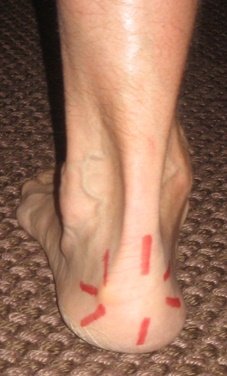
Nonsurgical Treatment for Insertional Achilles Tendonitis
The good news is that many patients with insertional Achilles tendonitis improve without surgery. Conservative treatment is generally the first step, and a structured treatment plan can help reduce pain, improve mobility, and restore function. Common non surgical methods include physical therapy, heel lifts, activity modification, shoe alterations, splints and booting, anti-inflammatory medications, and ice.
The Minimally Invasive Zadek Osteotomy: A Modern Alternative to Achilles Reconstruction
For decades, surgery for severe insertional Achilles tendonitis often involved a traditional open Achilles reconstruction. This operation may require a large incision at the back of the heel. Although this approach can be effective, it involves substantial work around the Achilles tendon and the soft tissues at the back of the heel. Recovery can be prolonged, and wound-healing complications are a concern because the skin in this region can be difficult to heal.
The minimally invasive Zadek osteotomy offers a different approach. Rather than relying on extensive Achilles tendon detachment and reconstruction, the surgeon makes a carefully planned cut in the heel bone, removes a small wedge of bone, and repositions the bone to change the shape and mechanics of the heel.
This changes the relationship between the Achilles tendon and the heel bone, helping reduce the forces and compression contributing to insertional Achilles tendon pain. Importantly, the procedure can preserve the Achilles tendon insertion rather than requiring the extensive tendon detachment often used in traditional surgery.
For appropriately selected patients, this makes the Zadek osteotomy an exciting advancement in the treatment of chronic insertional Achilles tendinopathy. Research has reported improvements in pain and function, with encouraging results from minimally invasive techniques.

Key ClientsLOGO
logo
Logo
LOGO